 |
Graflex.org Get help with your Graflex questions here This forum is temporarily read-only. |
| To hand hold a Crown Graphic | |
| Graflex.org Forum Index -> Speed Graphic Help | |
| Author | Message | ||
|---|---|---|---|
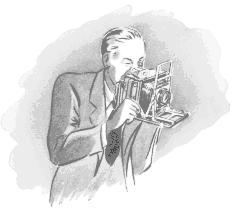
| primus96 Joined: 13 Nov 2003 Posts: 225 |  Posted: Thu Dec 11, 2003 1:33 pm I am wondering how to use it hand held for max stability. Should I have my right hand under the bed & trip the shutter with a cable release or hold the body with my right hand with the same cable release. I was looking for reccomendations, it seemed that if you hold the bed the camera is better balanced. I am not sure how comfortable that would be to hold and with a cable release in the same hand. A flash might be a different matter because my Metz 45 CT-1 is going to be on the r.h side of the camera. | ||
| RichS Joined: 18 Oct 2001 Posts: 1468 | Posted: Thu Dec 11, 2003 4:30 pm
 As I remember, I hedl the camera with my left hand. NOT palm-flat under the bed. More holding the left edge of the bed. That way you can steady the up/down motion. I steadied the camera with my right wrist/forearm as I fired the shutter with my right hand. Actually on the shutter, using no cable. The body release just doesn't seem to work well and I have mine disconnected because it doesn't work with all lenses... That said. I think this is all comes down to how comfortable and stable _you_ can hold the camera. How someone else does it may not help you. Try different positions. A mounted flash tube helps a lot but is in the way on the right side (for me) and you have to remove the handle for the left side. I also have used the handle, putting my hand between handle & camera body for more support. There are a lot of ways to hold the camera and no single way works in every situation. Just "play" and find your 'comfort zone' | ||
| Les Joined: 09 May 2001 Posts: 2682 | Posted: Thu Dec 11, 2003 5:52 pm I tied a cable release to the top of the handle, then with my left hand between the handle and body I could hold the camera. To shoot I brought the camera up to my head, resting in on my forehead, the right hand focused the lens with thumb and forefinger and the other fingers were under the bed for support. I also pulled the camera into my body this way. the left hand took most of the weight and tripped the shutter. If I used a flash I used my right fore arm to take some of the weight off my left wrist as I dont have a solenoid to trip the shutter on that particular Crown. Les | ||
| alecj Joined: 09 May 2001 Posts: 853 | Posted: Sat Dec 13, 2003 4:27 pm To me, that's a great benefit of the solenoid. Even if you aren't using flash, the battery handle is great to hold with the right hand [tripping the shutter with the button]. For me, the left hand underneath the bed seemed more stable. With the Century, nothing beats the Graflex handle on the left side. | ||
| troublemaker Joined: 24 Nov 2003 Posts: 715 | Posted: Sun Dec 14, 2003 1:01 am Two more cents worth... I like to shoot verticles often. I have found that with Century, and especially my heavier Speed 23 and Crown 45, that i can rest the camera on my left shoulder quite comfortably and this offers quick viewing back and forth between the RF and optical view finder on all three of these, the Crown being top RF dons't matter. MY left hand can support the camera easily because the left elbow rests against me and offers fairly stable focussing done by the right hand which is free to reach around (hey, everyone needs a good reach around). This has worked with my 35mm rather well shooting sailboats from a small skiff. The elbow stabalizes while the wrist and hips allow for the bobbing of the small boat, very flexible. This is why i got a mini Speed with a faster focal shutter. I have yet to try it, but am confident i can make this work for me. I can hand hold a 35mm down to 1/60 with good results if i can sit down and put my elbows on my knees; this i do regulary in the backcountry doing landscapes etc... IT is also nice to have something solid to lean on whether a car, wall, fence etc.. The proper way apperas to be as mentioned, put left hand under strap and grasp camera body. My Speed pinches my fingers this way, but not the others. I took the strap off my Crown because it is ugly, and will put it back on because i almost dropped it. I am going to make a couple custom nylon web straps for comfort, the stock units are cool, but make the back of my hand sore after a few minutes of play. take care Steve | ||
| paxety Joined: 10 Sep 2003 Posts: 69 | Posted: Mon Dec 15, 2003 3:49 pm Also, don't forget the shooter's trick. Take a deep breath, let half of it out. Hold your breath and trip the shutter. john | ||
| clnfrd Joined: 26 Mar 2002 Posts: 616 | Posted: Mon Dec 15, 2003 10:56 pm Only one real way to hold a Graphic...the classic way: adjust the strap so you can run your left hand through it, wrap your fingers around the front of the camera, your finger nails barely touching the bellows...and shoot! If you get jiggles, use a faster shutter speed. If you want to use a tripod and all that stuff, get a view. Fred. | ||
| essessem Joined: 19 Feb 2003 Posts: 48 | Posted: Tue Mar 02, 2004 10:36 pm I know it's been posted before, but this would be a good post to add recommended shutter speed to avoid camera shake. I remember there's a rule of thumb based on focal length, (or was it ASA?) | ||
| t.r.sanford Joined: 10 Nov 2003 Posts: 812 | Posted: Wed Mar 03, 2004 1:48 am That rule, as I learned it many years ago, applied to miniature cameras. It was, simply, that you should use a shutter speed whose denominator was about the same number as the focal length of the lens in millimeters. Thus, for a 35mm. camera with a 50mm. lens, you would use 1/50 or 1/60; if you attached a 135mm. lens, you'd use 1/125 (or 1/150, if you had an "Exakta VX"). The conventional wisdom was that, if you used the marksman's principles described in an earlier post -- the "eight steady hold factors" and "Breathe, Relax, Aim, Slack, Squeeze" -- you could use the next longer shutter speed. It seems to work in practice. However, the starting-point for this kind of thing has to be the maximum acceptable blur circle, which is a lot smaller for a camera whose negatives must be enlarged 7X or 8X to make an 8x10 print than for one producing a 4x5 negative. Also, the mass of a "Speed Graphic" (not weight; it isn't a heavy camera at all; but mass) gives it a good deal of inertia. Only the really hefty 35mm. cameras, the old Zeiss "Contarex" for example, come close, but even they are a bit too small for comfort. This makes the "Graphic" very resistant to shake, in my experience. Conservatively, you might halve the miniature-camera rule, and try not to make too many exposures at 1/25 sec. with a 135mm. lens, and fewer with a 150mm. or 180mm... | ||
| All times are GMT |
Read-only archive of a phpBB 2 board · Powered by phpBB © 2001, 2005 phpBB Group